
- Population
- 1,609,675
- 1.6M
- Elevation
- 44 m
- above sea level
- Local time
- UTC+01:00
- Europe/Berlin · UTC+01:00
- Places inside
- 1,443
- listed under Mecklenburg-Vorpommern
- Airports
- RLG Rostock-Laage Airport17 km
- HDF Heringsdorf Airport109 km
About Mecklenburg-Vorpommern
Mecklenburg-Vorpommern is a region. Location: Germany. Population: 1,609,675.
Mecklenburg-Vorpommern (MV; German: [ˌmeːklənbʊʁkˈfoːɐ̯pɔmɐn] or [ˌmɛk-] ; Low German: Mäkelborg-Vörpommern), often known by its anglicised name Mecklenburg–West Pomerania, is a coastal state in the north-east of Germany. Of the country's sixteen states, Mecklenburg-Vorpommern ranks 14th in population; it covers an area of 23,300 km2 (9,000 sq mi), making it the sixth largest German state in area; and it is 16th in population density. Schwerin is the state capital and Rostock is the largest city.
Source: Wikipedia · CC BY-SA 4.0
Travel notes for Mecklenburg-Vorpommern
From Wikivoyage
Mecklenburg-Western Pomerania (German: Mecklenburg-Vorpommern) is a state in northeastern Germany with a population of approximately 1.6 million. It is bordered by the Baltic Sea to the north, Poland to the east, and the states of Brandenburg, Lower Saxony, and Schleswig-Holstein. While often abbreviated as Meck-Pomm in casual German, it remains one of the most popular domestic travel destinations due to its extensive coastline.
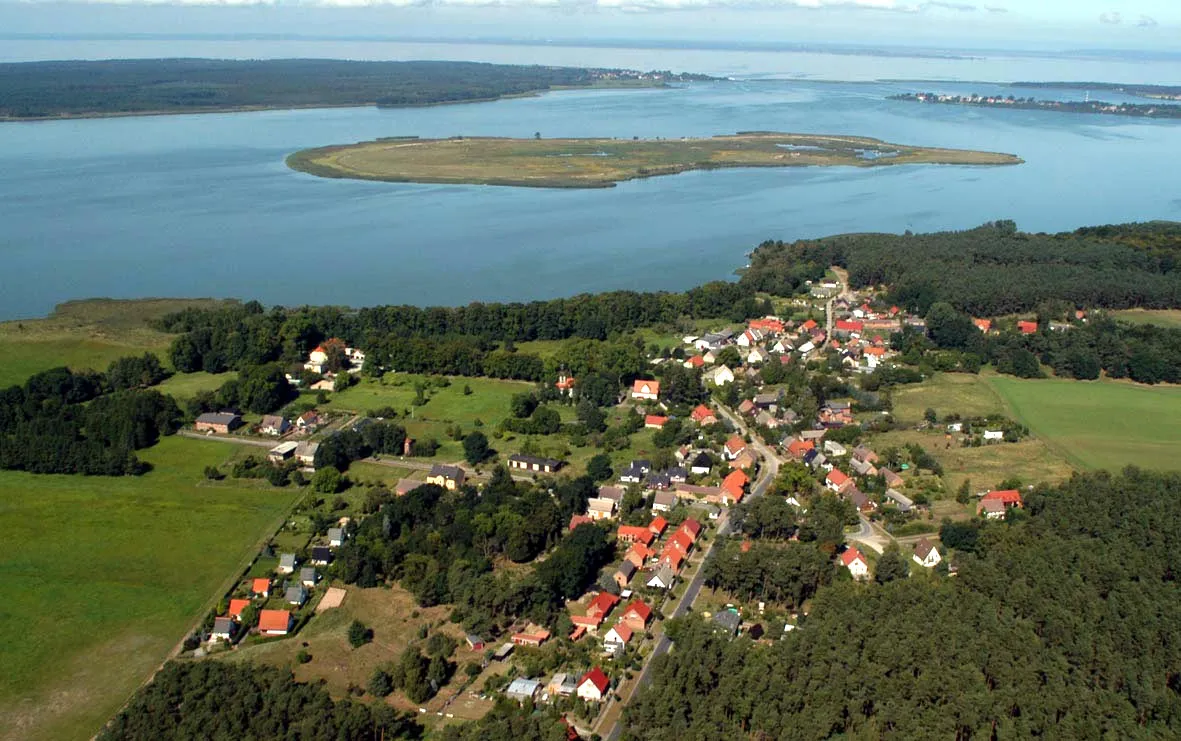
As Germany's least densely populated state, it is defined by its vast nature reserves and a largely flat landscape. The interior features the Mecklenburg Lake District, a network of over a thousand glacial lakes. Along the coast, the region is known for its historic seaside resorts (Seebäder) with their characteristic 19th-century "resort architecture" and wide, sandy beaches. The state's cultural heritage also includes numerous manor houses, Brick Gothic cathedrals, and well-preserved medieval town centres, two of which are UNESCO World Heritage sites.
Understand+
Mecklenburg (originally pronounced with a long "e") Vorpommern is the least densely populated German state, but has been a major (domestic) tourist destination as early as the 19th century. As some of Germany's (historically) most important Baltic ports are here, its cities were among the preeminent in the Hanseatic League (though it was de facto led by Lübeck just across the state border to the west), as well as a desired prize for all Baltic powers. As such pieces of it belonged to Sweden for a long time, starting with the thirty years war (1618-1648) and later Prussia acquired the eastern parts.
Trade and shipbuilding have always been important for coastal cities like Rostock and its port Warnemünde and the GDR heavily depended upon its Baltic seacoast both for tourism and other economic activities such as fishery and ship-building. After the fall of the GDR the crisis hit this area particularly hard, as the shipyards could not deal with the new competition (mostly from Korea) and East Germans eager to explore their new-found freedom of travel stopped vacationing in the seaside resorts. However, starting in the mid 1990s tourism has bounced back, as even Western Germans have discovered the allure of the Baltic Sea and many East Germans returned to the vacation spot of their youth. While the shipyards still haven't quite turned the corner they have now specialized in (more expensive) military and specialist vessels.
Another promising field is renewable energy, as the coast is very windy and the entire state is rather flat, making it the ideal site for windmills and their production. Tourism is still mostly geared towards Germans and (to a lesser degree) their neighbors to the east, particularly Poland. As this was the main beach destination in GDR times FKK (Freikörperkultur, that is naturism or nude bathing) is the norm rather than the exception.
Tourist information:
Mecklenburg-Western Pomerania tourism website
Get in+
By plane:
Rostock airport (Laage, RLG IATA) has few international flights, so the best choices are usually Berlin Brandenburg Airport or Hamburg Airport.
By train:
Trains from Hamburg and Berlin to the major cities (Rostock, Schwerin, Stralsund) leave every 1-2 hours. There are also regular train connections from Poland (Szczecin).
By boat:
From Denmark (Gedser) there are frequent ferry connections to Rostock. Trelleborg in Sweden has several departures a day to Rostock and Sassnitz on Rügen. There are also ferry lines from several Eastern Baltic ports, primarily to Rostock.
By car:
The fast motorway network (Autobahn) has been considerably extended during the last years and all larger cities now have excellent connections. In the summer months, especially on weekends, the motorways and all roads to the coast can be congested.
By bus:
While they are a comparatively new phenomenon, Intercity buses in Germany serve most major and some minor towns throughout the country with prices often surprisingly low to compete with the better comfort and journey time of trains.
Source: Wikivoyage · CC BY-SA 4.0 · abridged
Places bordering Mecklenburg-Vorpommern
Population of Mecklenburg-Vorpommern over time
| 2013 | 1,596,500 | |
|---|---|---|
| 2018 | 1,609,675 | |
| 2022 | 1,570,817 |
Censuses and official estimates; source: Wikidata.
Climate of Mecklenburg-Vorpommern
Best months for sightseeingBest months for sightseeing: June–August.
This month · November
A cold month
Day 7° · Night 2° · Rain 46 mm
- Hottest month
- July (day 22°)
- Coldest month
- January (night -3°)
- Wettest month
- June (62 mm)
- Driest month
- February (32 mm)
Bars: average monthly low and high temperature. Below: precipitation. Monthly averages for 1970–2000 at about 18 km resolution, adjusted for elevation. Highlighted months are mild and relatively dry. Source: WorldClim 2.1 (CC BY 4.0).
Show values as a table
| Month | Jan | Feb | Mar | Apr | May | Jun | Jul | Aug | Sep | Oct | Nov | Dec |
|---|---|---|---|---|---|---|---|---|---|---|---|---|
| Average high (°C) | 2° | 3° | 7° | 12° | 17° | 20° | 22° | 22° | 18° | 13° | 7° | 3° |
| Average low (°C) | -3° | -3° | 0° | 3° | 7° | 10° | 12° | 12° | 9° | 6° | 2° | -1° |
| Precipitation (mm) | 41 | 32 | 37 | 35 | 51 | 62 | 62 | 58 | 47 | 39 | 46 | 46 |
How to get to Mecklenburg-Vorpommern
The nearest airport is Rostock-Laage Airport (RLG), 17 km to the northwest as the crow flies. The nearest large city is Rostock, 37 km to the northwest.
Airports
- Rostock-Laage Airport (RLG) Laage 17 kmnorthwest
- Heringsdorf Airport (HDF) Zirchow 109 kmeast
- Lübeck Blankensee Airport (LBC) Lübeck 117 kmwest
Nearby large cities
- Rostock Population: 198.3K 37 kmnorthwest
- Lübeck Population: 212.2K 119 kmwest
- Berlin Population: 3.4M 158 kmsoutheast
- Kiel Population: 252.7K 164 kmwest
- Potsdam Population: 184.8K 164 kmsouth
Straight-line distances; road distances are longer. Airport data: OurAirports.
Places in Mecklenburg-Vorpommern
1,443 placesMountains & nature37
- Dammbruch · Natural site
- Dammerower Forst · Natural site
- Dammer Tannen · Natural site
- Dammfeld · Natural site
- Dänische Wiek · Natural site
- Darzer Tannen · Natural site
- Das Große Holz · Natural site
- Das Runde Holz · Natural site
- Demminer Stadtforst · Natural site
- Demminer Stadtwald · Natural site
- Demminholz · Natural site
- Demziner Busch · Natural site
- Demziner Forst · Natural site
- Der Horn · Natural site
- Der Lindenwald · Natural site
- Dicke Hege · Natural site
- Die Bergkaveln · Natural site
- Die Birken · Natural site
- Die Buchen · Natural site
- Die Dick · Natural site
- Die Durnow · Natural site
- Die Glase · Natural site
- Die Horst · Natural site
- Die Lemmbrach · Natural site
- Die Mordkuhle · Natural site
- Die Söring · Natural site
- Die Stuers · Natural site
- Divitzer Forst · Natural site
- Dobbertiner Klosterforst · Natural site
- Dobbertiner Klosterforst · Natural site
- Doberaner Holz · Natural site
- Dodower Forst · Natural site
- Dohlen · Natural site
- Dölitzer Wald · Natural site
- Dollekamp · Natural site
- Domsühler Tannen · Natural site
- Dorf Tannen · Natural site
Lakes, rivers & coasts23
- Dänholm · Island
- Dannhusener See · Lake
- Datze River · River
- Dehmer See · Lake
- Deichelsee · Lake
- Demminsee · Lake
- Derliener See · Lake
- Der Obere See · Lake
- Der See · Lake
- Deviner See · Lake
- Die Döpe · Lake
- Die Drei Pöhlen · Lake
- Die Lanken · Lake
- Die Mössel · Lake
- Die Plan Bek · River
- Die Schlucht · River
- Dobbertiner See · Lake
- Dobbiner See · Lake
- Dolgener See · Lake
- Domjüchsee · Lake
- Dorfsee · Lake
- Dorfsee · Lake
- Dreetzsee · Lake
Largest cities and towns
-
Greifswald Village, Vorpommern-Greifswald56.1K
-
Wolgast Village, Vorpommern-Greifswald11K
-
Anklam Village, Vorpommern-Greifswald11.9K
-
Rostock Village, Kreisfreie Stadt Rostock205.3K
-
Rostock City, Rostock198.3K
-
Schwerin, Landeshauptstadt Village, Kreisfreie Stadt Schwerin98.3K
-
Neubrandenburg Village, Mecklenburgische Seenplatte60.3K
-
Stralsund, Hansestadt Village, Landkreis Vorpommern-Rügen54.1K
Nature and heritage in Mecklenburg-Vorpommern
Sources & licences
Data last updated: · 2 independent sources