- Population
- 15,757
- 15.8K
- Elevation
- 24 m
- above sea level
- Local time
- UTC+00:00
- Europe/London · UTC+00:00
- Airports
- INV Inverness Airport103 km
- GLA Glasgow Airport113 km
About Fort William
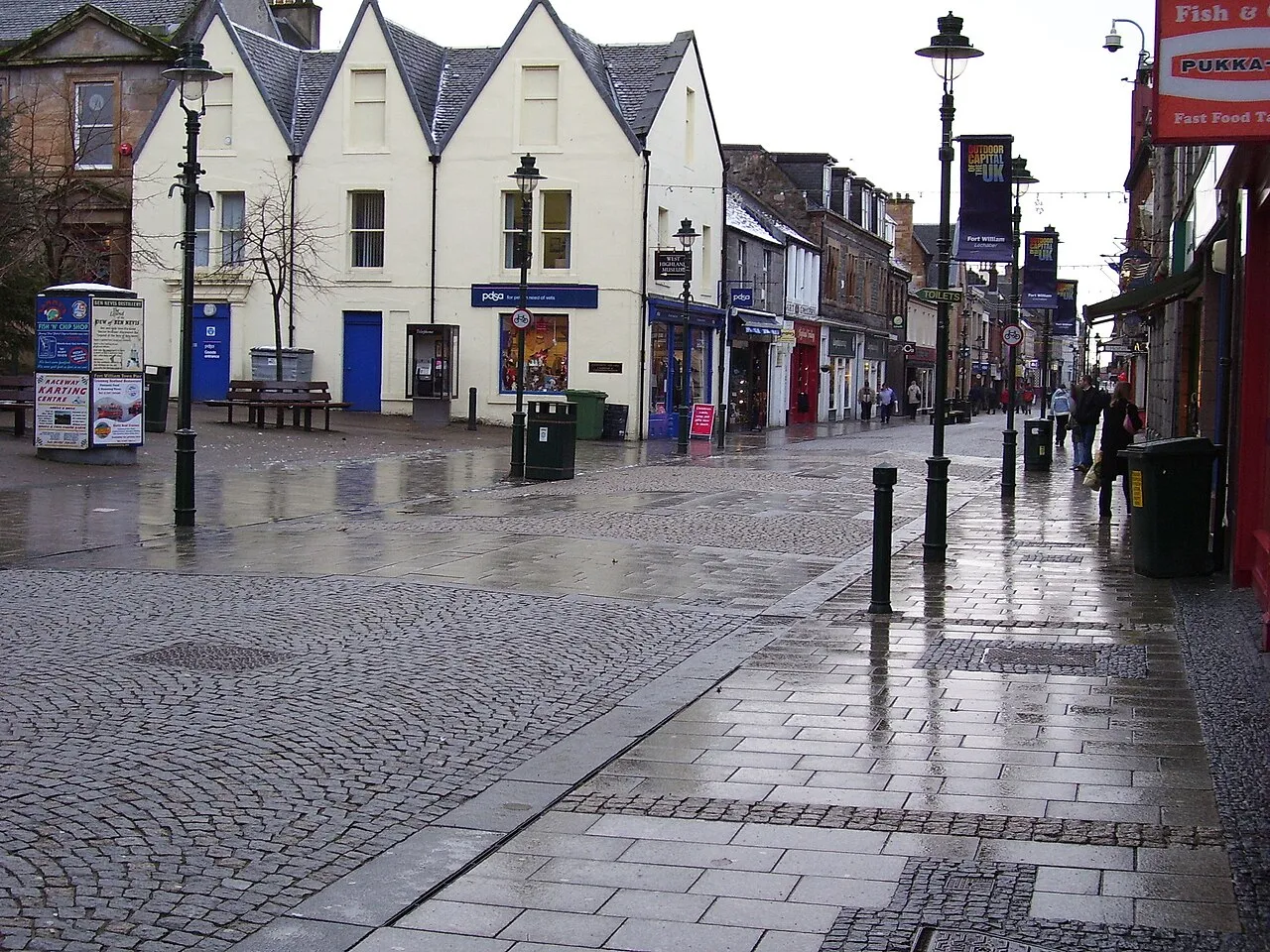
Fort William is a town. Location: Inverness-shire, Highland. Population: 15,757. Elevation: 24 m.
Fort William is a town in the Lochaber region of the Scottish Highlands, located at the head of Loch Linnhe. At the 2011 census, Fort William had a population of 15,757, making it the second-largest settlement in both the Highland council area and in the Scottish Highlands as a whole; only the city of Inverness has a larger population. Fort William is a major tourist centre with Glen Coe just to the south, Ben Nevis and Aonach Mòr to the east, and Glenfinnan to the west.
Source: Wikipedia · CC BY-SA 4.0
Photos of Fort William
-

Robert Linsdell from St. Andrews, Canada · CC BY 2.0 -

Peter S · CC BY-SA 2.0 -

Bill Kasman · CC BY-SA 2.0 -

Lucas Kendall · CC BY-SA 2.0 -

Lucas Kendall · CC BY-SA 2.0


Travel notes for Fort William
From Wikivoyage
Fort William is a town at the foot of the Great Glen, on the west coast of the Scottish Highlands. It's the main transport, commercial and visitor hub for the area: its attractions include Ben Nevis, Nevis Range ski resort, the Caledonian Canal, and "The Jacobite" steam train.
The town in 2021 had a population of 5630. A couple of miles north is a secondary built-up area, with the villages of Inverlochy, Caol, Bannavie and Corpach totalling another 5000 population; their facilities are also described on this page.
Understand+
The Great Glen is a long fault line slicing diagonally across the Highlands. Inland along its valley are a string of freshwater lakes: Loch Lochy, Loch Oich and Loch Ness. The southwest end of the valley is flooded by the sea to create a fjord, Loch Linnhe. The glen has always been a natural transport route, which nervous London rulers sought to control by a series of fortresses: Fort George and Inverness Castle at the northeast end, Fort Augustus in the middle, and Fort William at the southwest end. In 1745-46 the Jacobites smashed their way down this line of dominos and besieged Fort William, but it not only stood firm, but launched counter-attacks, a tough Hanoverian thistle in the rebels' backsides.
In the aftermath the kilt was banned and the Highlanders repressed, then the kilt and Highland customs were re-invented for genteel tastes in the late Georgian era as Scottish tourism was born. The town's original settlement and medieval castle were a couple of miles north at Inverlochy, but gravitated south to the new fort and harbour. In 1822 the Caledonian Canal was built through the Great Glen: interminable wars with France made the Channel too dangerous, but rounding Cape Wrath in the far north was also dangerous, hence the need for a navigable short cut. The post-Napoleonic peace made the canal redundant from the outset but it's now used by pleasure craft. The railway arrived in 1894 and tourist traffic boomed.
Tourist information is at Fort William iCentre, 15 High St, open daily 9:30AM-5PM.
Get in+
By plane:
Inverness Airport (INV IATA) is the closest, but since you need to hire a car anyway it's better to use Glasgow Airport.
Glasgow Airport (GLA IATA) has a better choice of flights and fares. Turn west onto M8 and cross the Erskine Bridge to join A82 northwards past Loch Lomond; maybe 2 hr 30 min to drive.
Oban Airport (OBN IATA) has flights to the Hebrides (effectively a flying school bus) but no connection to the mainland air network.
By train:
Trains from Glasgow Queen Street take four hours via Dumbarton, Helensburgh, Arrochar & Tarbet (for Loch Lomond), Crianlarich (where a portion divides for Oban) and Spean Bridge. There are five daytime trains M-Sa and two on Sunday. They continue west on the scenic West Highland Line to Glenfinnan, Arisaig and Mallaig, for ferries to Skye.
The Caledonian Highland Sleeper runs Su-F from London Euston, departing around 9:30PM to arrive at 10AM. (It divides at Edinburgh for Aberdeen and Inverness.) The southbound train leaves around 8PM (Sunday 7PM) to reach Euston towards 08:00. No trains on Saturday night. Compartments have two berths and are sold like hotel rooms: you pay extra for single occupancy, and you won't be sharing with a stranger. Tickets can be booked at any UK mainline railway station or online: the one-way fare in 2023 is £270 for two adults. You can also just use the sitting saloon, single £75. Pricing is dynamic with weekends costing more, if there are berths available. Booking is open 12 months ahead: you need to print out your e-ticket to present on boarding. You can also use the sleeper as a day-train between Dumbarton and Fort William, but it doesn't pick up in Glasgow.
Source: Wikivoyage · CC BY-SA 4.0 · abridged
Climate of Fort William
Best months for sightseeingBest months for sightseeing: July–August.
This month · November
A wet month
Day 9° · Night 4° · Rain 266 mm
- Hottest month
- July (day 18°)
- Coldest month
- February (night 2°)
- Wettest month
- January (288 mm)
- Driest month
- May (106 mm)
Bars: average monthly low and high temperature. Below: precipitation. Monthly averages for 1970–2000 at about 18 km resolution, adjusted for elevation. Highlighted months are mild and relatively dry. Source: WorldClim 2.1 (CC BY 4.0).
Show values as a table
| Month | Jan | Feb | Mar | Apr | May | Jun | Jul | Aug | Sep | Oct | Nov | Dec |
|---|---|---|---|---|---|---|---|---|---|---|---|---|
| Average high (°C) | 7° | 7° | 8° | 11° | 15° | 17° | 18° | 18° | 16° | 12° | 9° | 7° |
| Average low (°C) | 2° | 2° | 3° | 4° | 7° | 10° | 11° | 11° | 10° | 7° | 4° | 3° |
| Precipitation (mm) | 288 | 189 | 229 | 120 | 106 | 113 | 133 | 157 | 222 | 248 | 266 | 279 |
How to get to Fort William
The nearest airport is Inverness Airport (INV), 103 km to the northeast as the crow flies. For international flights: Glasgow Airport (GLA) (113 km). The nearest large city is Glasgow, 118 km to the southeast.
Airports
- Inverness Airport (INV) Inverness, Highland 103 kmnortheast
- Glasgow Airport (GLA) Glasgow 113 kmsouth
- Tiree Airport (TRE) Balemartine, Argyll and Bute 113 kmwest
Nearby large cities
- Glasgow Population: 626.4K 118 kmsoutheast
- Dundee Population: 148.2K 137 kmeast
- Edinburgh Population: 515K 153 kmsoutheast
- Aberdeen Population: 198.6K 187 kmeast
- Belfast Population: 348K 252 kmsouth
Straight-line distances; road distances are longer. Airport data: OurAirports.
Day trips from Fort William
Within 100 km: 44 historic and cultural sites, 4,845 natural sites, 1,355 lakes, rivers and coasts.
0–25 km398 places
- Eilean Dubh Island 22 kmW
- Eilean na Craoibhe Island 17 kmSW
- Eilean an Tuilaich Island 24 kmE
- Eilean na Fead Island 20 kmNE
25–60 km2,174 places
- Oronsay Island 53 kmW
- Eriska Island 37 kmSW
- Shuna Island Island 30 kmSW
- Eilean Shona Island 46 kmW
60–100 km3,672 places
- Isle of Skye Island 88 kmNW
- Island of Raasay Island 86 kmNW
- Eigg Island 65 kmW
- Scarba Island 80 kmSW
Straight-line distances.
Nearby attractions & nature
Everything nearby-
Cow Hill Mountain, Highland1.3 km SE
-
An Caol Island, Scotland1.2 km N
-
Eilean Fearna Island, Highland1.8 km NE
-
Black Parks Natural site, Highland2.2 km NE
-
Inverlochy Castle (Historical) Historic site, Highland2.5 km NE
-
Druim na h-Earba Mountain, Highland2.7 km S
-
Eilean Mòr Island, Highland2.3 km NE
-
Eilean a' Bhealaidh Island, Highland2.6 km N
Sources & licences
Data last updated: · 2 independent sources